Monday, October 21, 2013

Saturday, Oct 19th - A big day!

Internet has not been available, so I am dating my posts so readers will know what day I am writing about.  Saturday began with morning mass, a beautiful way to start the day.  The morning began with a visit from an old friend, Steven Werlin.  We chatted and walked to the new park and back and then heard a helicopter.  As it turns out, Saturday was the day of the park’s dedication.  If you read my blog from last January, you know that the park was finished then.  It has been locked up until now, awaiting this auspicious moment.  We walked back to the park, amidst throngs of people.  A group playing Haitian instruments, were playing.

A brass band was playing and the park was full of people.
Dignitaries were on the stage.  Officials who saw us led us up to the stage.  Guess we are VIPs too!  Fr. KK blessed the park, walking around to sprinkle it first with holy water, and a second time he used a censor (spelling??) to bless the park with incense.

 Numerous officials got up and spoke, including several government ministers, Deputy A. Rondon who has accomplished much for Cerca Carvajal, a Protestant minister and the mayor.  As we exited the park, children were playing on the swings and the slide and everyone was finally enjoying the park.
Colleen arrived around 4 pm.  Transportation was finally arranged from Port au Prince.  Sr. Mamoune picked her up at the Matthew 25 guesthouse and then Fr. Bloh graciously drove her to Cerca Carvajal.  She was thrilled to be back in Cerca Carvajal.

Other guests for the evening’s festivities arrived in time for dinner.  Around 10 pm, we could here the Konpa band warming up.  The seminarian, Jenico, walked with us down to the school yard.  Fr. KK had given us VIP passes which we hung around our necks.
A crowd had formed at the entrance as each person’s wrist band was checked.  About 200 people had gathered to hear the band, which we were told is the oldest Konpa band in Haiti.
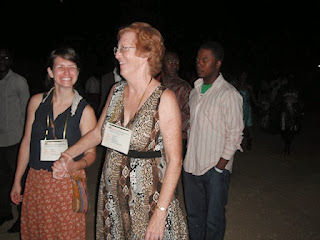
The music began, and it was LOUD, so loud that I could feel it vibrate in my bones.  At first, no one danced.  Colleen began swaying to the music.  After a while, she and I began to dance, drawing a crowd as curious onlookers gathered to watch us crazy "blan" (white people) dance. 


After that first dance, others asked each of us to dance.  Konpa dancing is a kind of slow two step dance.  It doesn’t sound like it would be tiring, but after an hour and a half, I was dripping with sweat, and exhausted.  ! We called it a night around midnight, way past my usual bedtime!

Wed-Fri Oct 16-18

Well as you might guess, internet has been spotty so I haven't been able to post when I want.  I wrote this post last week so I could post when internet was available!

For the past several nights, there has been music in the school yard.  I went down to check it out.  Many many young people were standing around.  There was a cluster of young men standing in a clump around what appeared similar to a roulette table.  There were plastic animals in the center which turned as the wheel spun.  There were numbered squares under the roulette wheel.  I am not sure of the rules of the game but everyone seemed to be enjoying it.  Young people stood around in clusters in the age old games of getting to know members of the opposite sex.  A few couples danced; several were girls dancing together.  There is definitely excitement in the air.  Tomorrow there will be a jazz concert and people are coming from miles around to hear it.

Friday, October 18, 2013

The road from Hinche to Cerca

Cerca Carvajal lies north and east on Hinche, about 16 km (about 10 miles) from Hinche but it generally takes about an hour to travel.  The first section of the road, from Hinche to Colladere, was already in progress, because it is part of National Route 3, from Hinche to Cap Haitien.  The local deputy (representative in Parliament) has found funds for the rest of the road to Cerca from China (Taiwan I think).  I counted 10 water crossings between Hinche and Cerca Carvajal in January.  They have installed culverts in two of them already so that is helping.  It is the rainy season now, so when it rains, the roads turn to mud if they are not paved.  It is quite something to watch the road in progress.  They have been working on the extension of Rt 3 from Hinche for at least a year.  They have brought loads and loads of dirt to raise the level of the road and to provide a good base for paving.  There is a lot of heavy equipment in use; it seems to take forever to me, but the Haitians are an extremely patient people who are happy to see progress being made.  I hope and pray that these new roads serve to open up the country and to bring opportunity to these poor rural areas!

A new seminarian for Cerca Carvajal


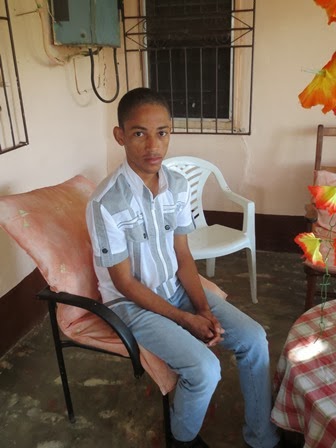
Introducing the new seminarian Abe (his title, like Fr., for seminarians who are not yet deacons) Dieunico Augustin (pronounced Jenico, kind of like Jericho with an “n”).  He was born in Croix Fer, a village near the town of Belladere and has one sister and five brothers.  His father passed away, and his mother has a small garden and also is a ti marchan (little merchant).  These market women but quantities of something (rice, oil, shoes, candies, detergent etc.) and then portion it out and sell these smaller portions at the open air market.  Those who have this as their main business travel from market to market, since in most small towns, market day is only once a week.  But back to Dieunico.  He went to primary school and began secondary school in Croix Fer, and finished secondary school in Belladere (probably because there was no secondary school in Croix Fer).  He expressed interest to his pastor in becoming a priest so he then spent once year working with him.  After that, he went to the minor seminary (Propadeutique) for one year, studied philosophy at the seminary in Port au Prince and is now spending one year with Fr. KK here in Cerca Carvajal.  After than he will spend 2-4 years in an as yet unspecified foreign country studying theology, come back for one year of work experience, before becoming a deacon for a year before he is ordained, a total of 11 years from the time of expressing interest in becoming a priest.  He is 23 years old now. 


I asked him what he is doing while here in Cerca.  He told me he is “accompanying secondary school students”.  I asked him to explain the difference between accompanying and teaching.  He told me that he does teach catechism, but he also offers advice to students.  I asked him if people are different here than in Croix Fer or Belladere.  He told me that people in Croix Fer and Belladere are more active.  I asked him what he meant by this.  He said that Belladere is close to the Domincan Republic and there is a lot of commerce back and forth.  He suspects that people are poorer here because of that lack of commerce.  I asked what one could do to help people become more active.  He said that he thinks that having a decent road will make a huge difference because it will enable more commerce when the road is finished.

The agricultural exposition

This has been planned for months so I was anxious to check it out, not least because our rabbit raisers are planning to show off their rabbits.  Hope they find some buyers!

Today I visited the exposition for the first time, but I will have to return with gourdes.  Dieunico accompanied me to help explain everything, mostly in Kreyol. Today is a holiday in memory of a Haitian forefather named Jean Jacques Dessalines so there is no school  The speakers play kompa music loud enough to be heard at the presbytere (the rectory).  I would like to upload a short movie but I know the slow internet connection won’t allow that so I will have to settle for some photos.
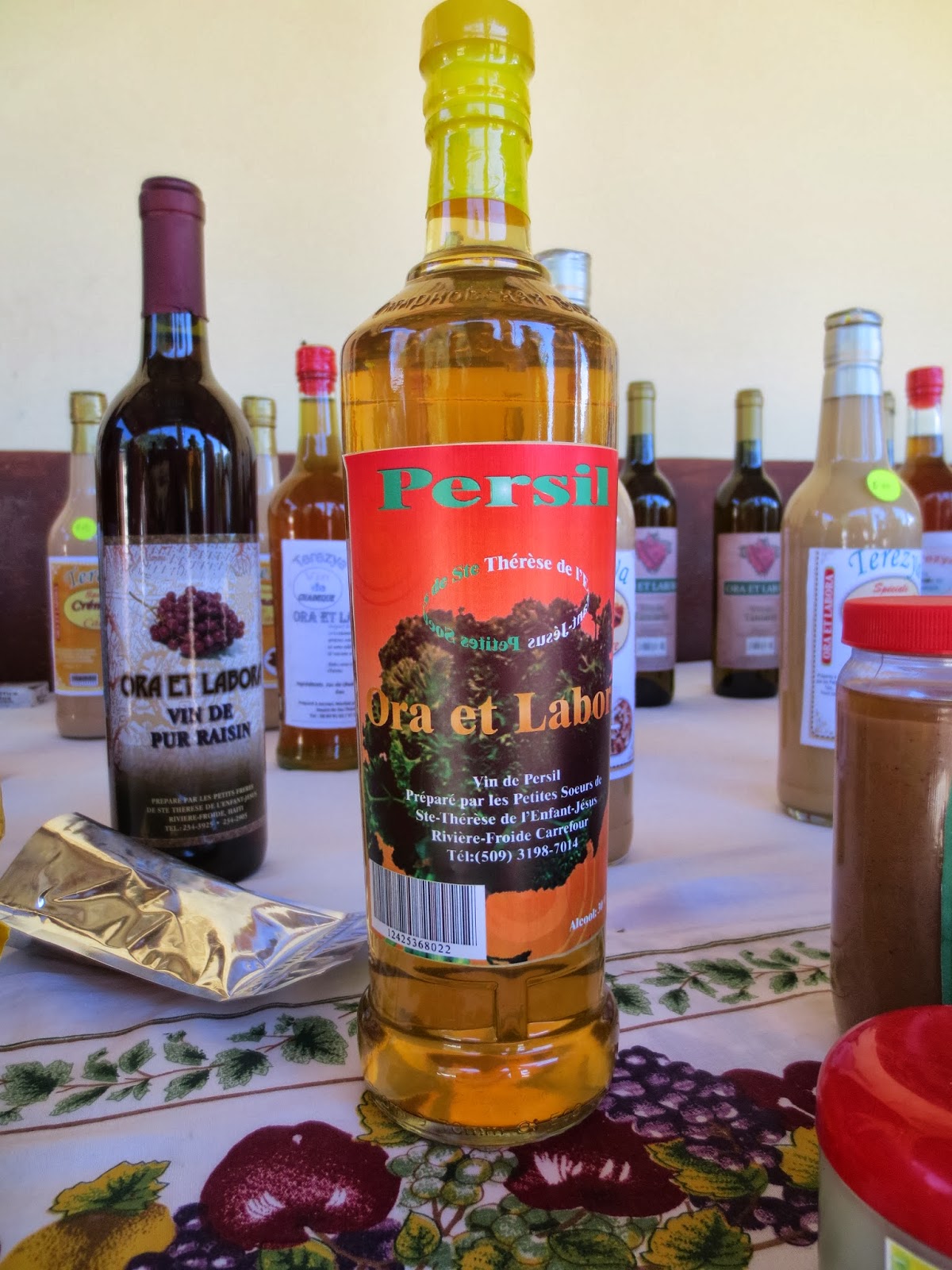
The little sisters (Petite Soeur) a religious congration has increased the number of products they make.  They had all kinds of wines including parsley wine, wine from grenadine, mixed fruit wine that includes orange and others I would never have thought you could make wine from.  Note the "Ora et Labora" on the labels!  They also had a pomade for hair and a body cream made from papaya. 


The sisters also had a purse made from some kind of plastic table cloth that is quite attractive. 
I asked for a sample of the parsley wine because I couldn’t even imagine what it would taste like.  We were invited to the sisters’ house for a taste.  I think it had more alcohol than most wines, kind of like a sweeter wine like a port.  It had an unusual taste but was good.  I don’t think it tastes much like parsley!
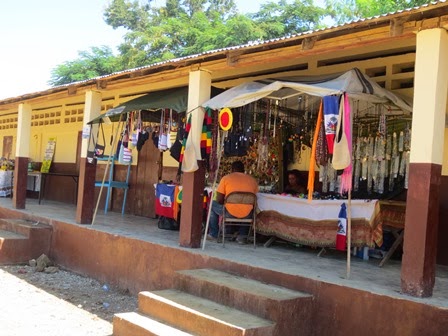
Another booth on the large porch outside the primary classrooms had many kinds of jewelry, necklaces, bracelets and earrings as well as small handmade purses. 
There were several stands that had agricultural products such as pomdete (potatoes), patat (sweet potatoes), Malaga (?) Looks like another kind of sweet potato), chadek (tastes like grapefruit), papaye (papaya) tomat (tomatoes), kan (sugar cane) and ananas (pineapples).  Another booth had prepared foods including what looked to be peanut brittle, corn bread, and an assortment of preserves and peanut butter.  They also had sweet milk which I presume is made from canned evaporated milk and sugar, a kind of sweetened condensed milk.  As far as I know, there are no dairy cattle in Haiti, so the only kind of milk is either non-fat milk powder or canned condensed milk.


Another booth had prepared “chako” a kind of soup made from black beans and corn and apparently some kind of squash that we couldn’t find an English translation for.  The corn reminded me of hominy.  The soup was good!


I visited someone exhibiting rabbits, but unfortunately, no one has bought any.  In fact, there are few visitors to the exposition unfortunately!

Another thing I observed is common in Haiti, but somehow unbelievable: people making gravel by hand.  They take a hammer and a large rock and pound it into ever smaller pieces.  Many people earn their living this way.  Incredibly hard work beginning with hauling the large rocks to the continual hammering!

Thursday, October 17, 2013

A walk around Cerca Carvajal

After breakfast on Tuesday October 15th, I headed for the new park and kept going straight.  About a block past the park, workers are working to install pavers on the road.  A major improvement!  I had asked Fr. KK about this, telling him that it is much more expensive in the US to use pavers than to use concrete.  He was surprised because pavers are the cheapest option here.  


I continued past the construction to a dirt road with modest homes with small gardens on either side.  I asked one woman if I could take her picture and she was happy to have me take it.


Another time, I was photographing a garden but no one was in the photo. I was asked for money.  Haitians assume that photographers are going to sell their photos and quite reasonably feel entitled to share in the proceeds.  I tried to explain that I take pictures to help people in the US understand life in Haiti.  A small group of people listened to our conversation.  They explained that they need help because life is difficult.  I tried to explain that we at St. Edward are looking for projects that will help people earn money so that  they can take care of their families.  I told them that our rabbit project was planned to do just that.  They told me that, because they are Protestant and not Catholic, they did not receive rabbits.  Sigh!  I told them that the people of St. Edward want to help all of the people in Cerca Carvajal, that perhaps they could purchase rabbits and the trainer would provide training to them.  I wish we could find a way to bring Catholics and non-Catholics together!

Here are some other scenes from my walk:


The new computer teacher

Sony Orzile was born in the department (state) of Fort Liberte which is to the north of the central plateau about twenty minutes by car, or an hour on foot.  (I assume the road must be bad if the car is only three times as fast as walking!)  He lived with his father in Cap Haitien until he was 11; his father remarried and the new step-mother was not good to him so he decided to move back with his mother.  His mother had also remarried, and he didn’t get along with the new step-father so he moved in with his grandmother. His father refused to pay for his school and his mother and grandmother weren’t able to help him so he began working on the road to Cerca to earn money to go to school.  He finished his primary school living with his grandmother, and then managed to earn enough to go to school at Sacred Heart secondary school in Papaye which only contained grades 7-9 at that time.  He finished high school at St. Martin’s, working to pay the tuition.  He then studied computer engineering in the Dominican Republic earning qualifications in Oracle database and Java.  He graduated in 2010 and worked as a system manager.  He told me that life is very difficult for Haitians in the Dominican Republic.  There is much discrimination against them there, so now he has moved back to Haiti and is working at Holy Family School.  We are fortunate to have him!